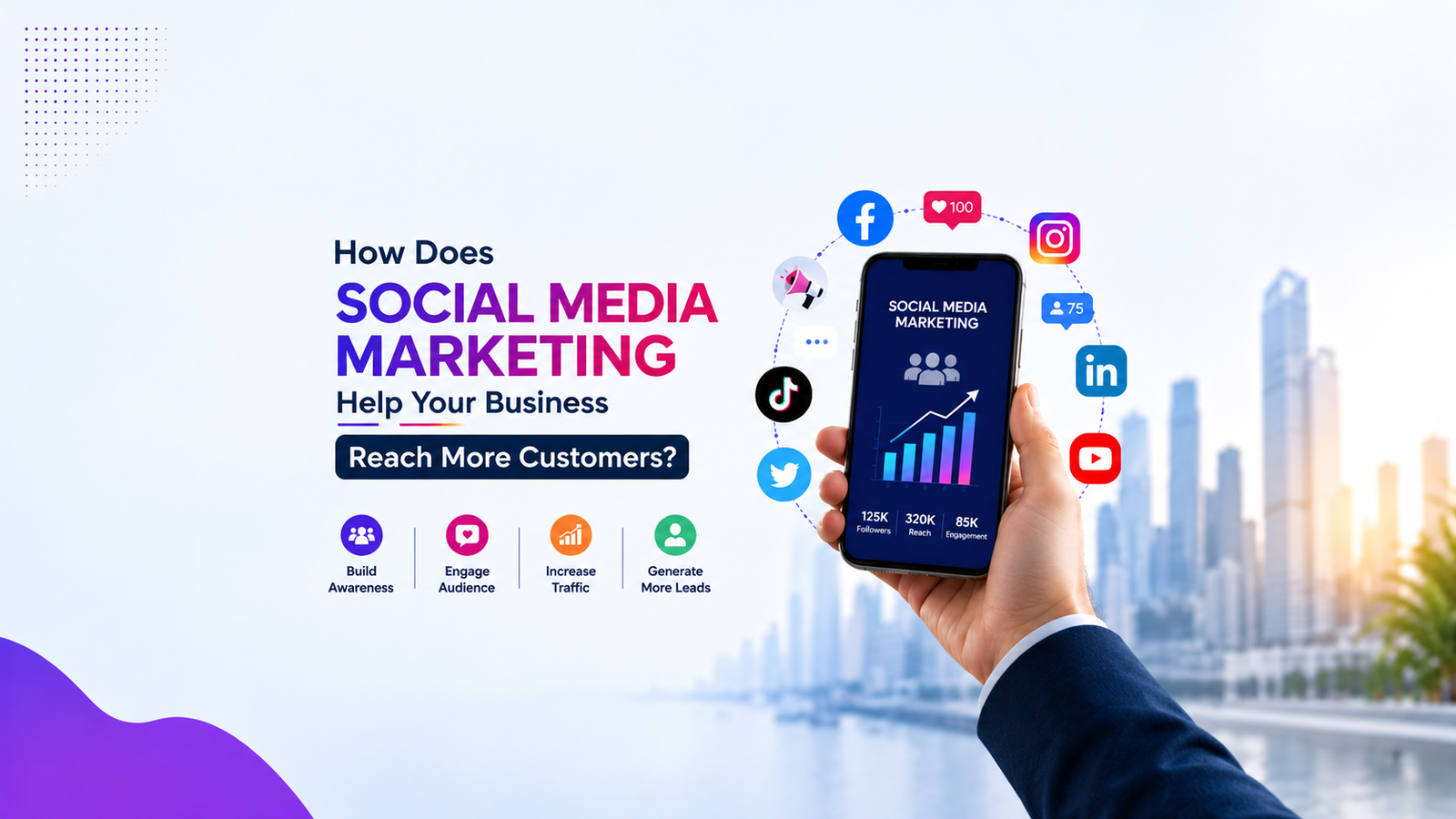
A few years ago, a business could depend heavily on its shop location, newspaper advertisements, referrals, or a sales team to find new customers. Things are different now; almost the entire world is focusing on social media marketing for businesses to reach more customers
People spend a considerable part of their day online. They scroll through Instagram while travelling, watch YouTube videos during breaks, check Facebook for local recommendations, and use LinkedIn to learn about companies and professionals.
Sometimes, they are not even looking for a particular business when they discover one.
A short video catches their attention. A photograph makes them curious. A useful post answers a question they have been thinking about. They visit the company’s profile, look at a few more posts, and perhaps save the page for later.
That small interaction can eventually become a sale.
This is one of the reasons social media marketing has become an important part of business promotion.
But there is a difference between being present on social media and using social media effectively. Simply uploading a post every day will not necessarily bring customers.
So, how does social media marketing actually help a business reach more people and turn online attention into genuine opportunities?
Let’s explore it.
Social Media Has Changed How Customers Find Businesses
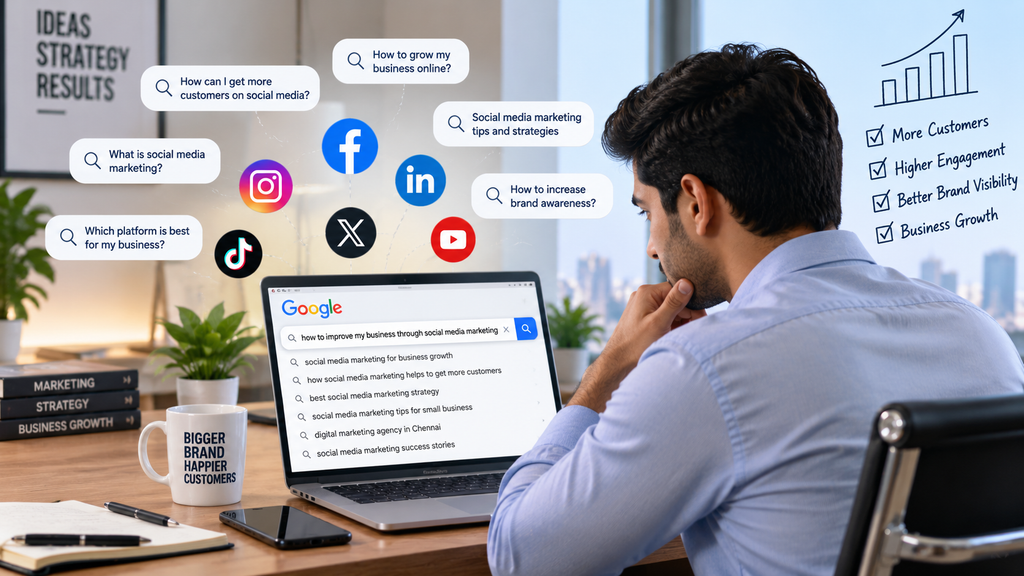
Think about your own buying habits.
If you need a restaurant, clothing store, interior designer, dentist, mobile phone or professional service, you might search online before making a decision.
But search is not always the first step.
Social platforms have become places where discovery happens naturally.
For businesses, this means there are opportunities to meet potential customers before those customers actively search for the company’s name.
That is a major advantage.
1. Your Business Can Become Visible to New People
A social media account gives a business another place to be discovered.
Consider a small Chennai-based furniture company. Its website may receive only a modest number of visitors each month. However, a well-made video showing a newly completed furniture project could reach people who have never visited the website.
People may share the video with their loved ones
Another person may save it because they are planning to renovate their home.
Someone else may visit the company’s profile to see more designs.
None of these people necessarily knew the company existed before seeing that content.
This is how social media can expand awareness beyond a business’s existing customer base.
2. You Can Speak Directly to the People You Want to Reach
Not every customer is interested in every product.
A company selling industrial equipment, for instance, may have very different customers from a fashion retailer. A coaching centre may speak mainly to students and parents, while a software company may focus on business owners and professionals.
Social media allows businesses to shape their communication around their intended audience.
A company can consider:
- The customer’s age group
- Location
- Interests
- Profession
- Problems
- Buying habits
- Type of product or service required
For a Chennai business, location can be particularly important.
A company may serve customers in Anna Nagar, Adyar, Velachery, Tambaram, OMR or other nearby areas. Content and advertising can be planned with those customers in mind.
The purpose is not to reach everybody.
It is to reach people who have a reasonable chance of becoming customers.
3. Helpful Posts Can Give People a Reason to Follow Your Brand
Nobody opens Instagram hoping to see twenty advertisements in a row.
People want information, entertainment, inspiration, ideas and sometimes simply something interesting to look at.
Businesses that understand this can create content that does not feel like a sales pitch every time.
For example, a dental clinic could explain simple mistakes people make while brushing.
A furniture business could show how to choose a dining table for a compact home.
A roofing company could explain what signs indicate that a roof needs maintenance.
A digital marketing agency could discuss why a website receives visitors but very few enquiries.
The business is still promoting itself, but indirectly.
It is demonstrating knowledge first.
When people repeatedly find useful information on a company’s page, they have a reason to keep following it.
4. Social Media Gives Your Brand a Human Side
A website tells customers about your company.
Social media can show them the people behind it.
This can make a considerable difference, particularly for businesses where trust influences purchasing decisions.
Show your team preparing for a project.
Take customers behind the scenes.
Share a glimpse of your office.
Explain how a product is made.
Introduce the people handling customer enquiries.
Show the actual work taking place instead of filling every post with stock photographs.
For example, a Chennai manufacturing company could post a short tour of its production unit. A customer who sees the machinery, workers and finished products gets a better understanding of the company than they would from a simple advertisement.
People often connect more easily with something they can see and understand.
5. Short Videos Can Communicate an Idea Quickly
You do not need a ten-minute presentation for everything.
Sometimes 30 seconds is enough.
Short videos are useful for demonstrations, tips, quick explanations and visual stories.
A business can create videos around questions customers ask regularly.
For instance:
“How do you choose the right office chair?”
“What should you check before renovating a kitchen?”
“When is the right time to have your commercial roof inspected? “
“What should a small business know before starting Google Ads?”
These topics are useful because they begin with something the audience already wants to know.
The video then becomes a way for the business to demonstrate its knowledge.
And if viewers find the information useful, they may explore the company’s other content.
6Questions Asked By The Customers Before They Buy
One useful feature of social media is the ability to have conversations.
Someone might comment under a post:
“Do you provide this service in Tambaram?”
Another customer may ask:
“What is the approximate price?”
Someone else may send a direct message asking about availability.
These conversations are valuable.
A potential customer who has taken the time to ask a question has already shown some interest.
A prompt, polite and useful response can move that person closer to contacting the business.
This is why social media management should not stop once a post has been published.
Comments and messages deserve attention too.
7. Customer Reviews Can Make a Difference
Imagine discovering two businesses online.
One has several genuine customer reviews and photographs of completed work.
The other has almost no information from previous customers.
Which one would you feel more comfortable contacting?
For many people, previous customer experiences provide an extra layer of confidence.
Businesses can use social media to showcase genuine testimonials, project results, customer photographs and feedback.
A construction company could share a completed project.
A restaurant could feature customer photographs.
A digital marketing agency could discuss a campaign and the lessons learned from it.
A service provider could explain how it solved a particular customer’s problem.
The important word here is genuine.
Social media should demonstrate real experiences rather than make exaggerated promises.
8. Social Media Can Bring People to Your Website
Your social media page does not have to be the final destination.
Sometimes its job is to create enough interest for someone to visit your website.
Suppose you publish a short post explaining three mistakes businesses make when choosing an advertising agency.
You could direct interested readers to a detailed article on your website.
A person who visits the article may then discover your services, read about your company and eventually submit an enquiry.
This creates a connection between social media and website traffic.
The same principle can work with videos, guides, product pages, case studies and service information.
Your social media account becomes one entrance to your wider online presence.
9. Paid Advertising Can Help You Reach a Chosen Audience
Organic content is valuable, but sometimes a business wants to reach a larger audience within a specific period.
Paid social media advertising can help with that.
Businesses can create campaigns around objectives such as:
- Generating leads
- Promoting a product
- Driving website visits
- Increasing enquiries
- Encouraging bookings
- Building awareness
However, paying for advertising does not automatically make a campaign successful.
Suppose an advertisement gets thousands of views but produces almost no enquiries.
The problem might be the audience.
It could be the message.
Perhaps the offer is unclear.
Maybe the landing page is difficult to use.
Good advertising therefore requires more than an attractive graphic. The entire journey—from advertisement to enquiry—needs to make sense.
10. Social Media Can Keep Your Business in Customers’ Minds
Not every person who sees your post is ready to buy immediately.
Someone may be researching today and make a purchase several weeks later.
Another person may follow your page now because they like your content and contact you when they eventually need your service.
Regular, useful communication helps keep the brand familiar.
This is especially valuable in industries where customers do not make purchases frequently.
You may not need to convince someone to buy today.
Sometimes you simply need to make sure they remember your business when the need arrives.
What Should a Chennai Business Post on Social Media?
There is no universal content calendar that works for every company.
A Chennai restaurant and a software development company should not have identical social media strategies.
Instead, start with customer questions.
People frequently asked question before buying?
What mistakes do they make?
Which information would make their decision easier?
What does your company know that your competitors rarely explain?
The answers can become content ideas.
A Chennai-based business can also include relevant local subjects when they genuinely add value. This could involve local customer needs, neighbourhood-specific services, seasonal demand or experiences related to the Chennai market.
Local relevance should feel natural.
There is no need to force the word “Chennai” into every caption.
Expert View: What Is More Important—Followers or Customers?
Expert insight: A large follower count can look impressive, but it does not automatically mean a business is succeeding.
Imagine one account with 50,000 followers and almost no enquiries.
Another account has 5,000 followers but regularly receives genuine customer enquiries.
For the business, the second account may be considerably more valuable.
This is why social media should be connected to actual business objectives.
Depending on the company, useful measurements could include:
- Website visits
- Enquiries
- Qualified leads
- Sales
- Bookings
- Engagement
- Cost per lead
- Conversion rate
The numbers that matter depend on what the business wants to achieve.
Frequently Asked Questions
Is social media marketing useful for small businesses?
Yes. Small businesses can use social media to introduce themselves, demonstrate their expertise, communicate with customers and build recognition without relying entirely on expensive traditional advertising.
How often should I post on social media?
There is no magic number. A realistic schedule that allows you to maintain quality is usually better than posting several times a day without a clear purpose.
Which platform is best for my business?
It depends on your audience. A visual business may find Instagram useful, while a B2B company may receive better opportunities through LinkedIn. Video-focused businesses may benefit from YouTube.
Can social media marketing increase sales?
It can contribute to sales by helping people discover a business, understand its products or services and communicate with the company. Actual results depend on the business, audience, offer and overall marketing strategy.
Does social media marketing work for Chennai businesses?
Yes. Businesses serving Chennai customers can use social media to build local awareness, demonstrate their services, communicate with nearby audiences and support their wider digital marketing efforts.
Do I need paid advertising?
Not necessarily. Organic content can build an audience over time. Paid campaigns are useful when a business wants additional reach or needs to promote a specific product, offer or lead-generation campaign.
Final Thoughts
Social media marketing is not simply about filling your business profile with posts.
It is about being present when potential customers are paying attention.
A useful video can introduce your company to someone new. A practical post can answer a question. A customer testimonial can remove doubt. A direct-message conversation can lead to an enquiry. A link to your website can give an interested person more information.
None of these actions guarantees a sale on its own.
But together, they create a path.
For businesses in Chennai, that path can be especially valuable because customers are increasingly able to discover, compare and communicate with companies without leaving their phones.
The businesses that benefit most are not necessarily the ones posting the most content.
They are the ones that understand who they are talking to, what those people need and how their content can genuinely help.
That is the real strength of social media marketing.
It does not merely put your business in front of more people.
It gives you a chance to be remembered by the people who may actually become your customers.
for further queries,suggestions and to know about how to get a complete