
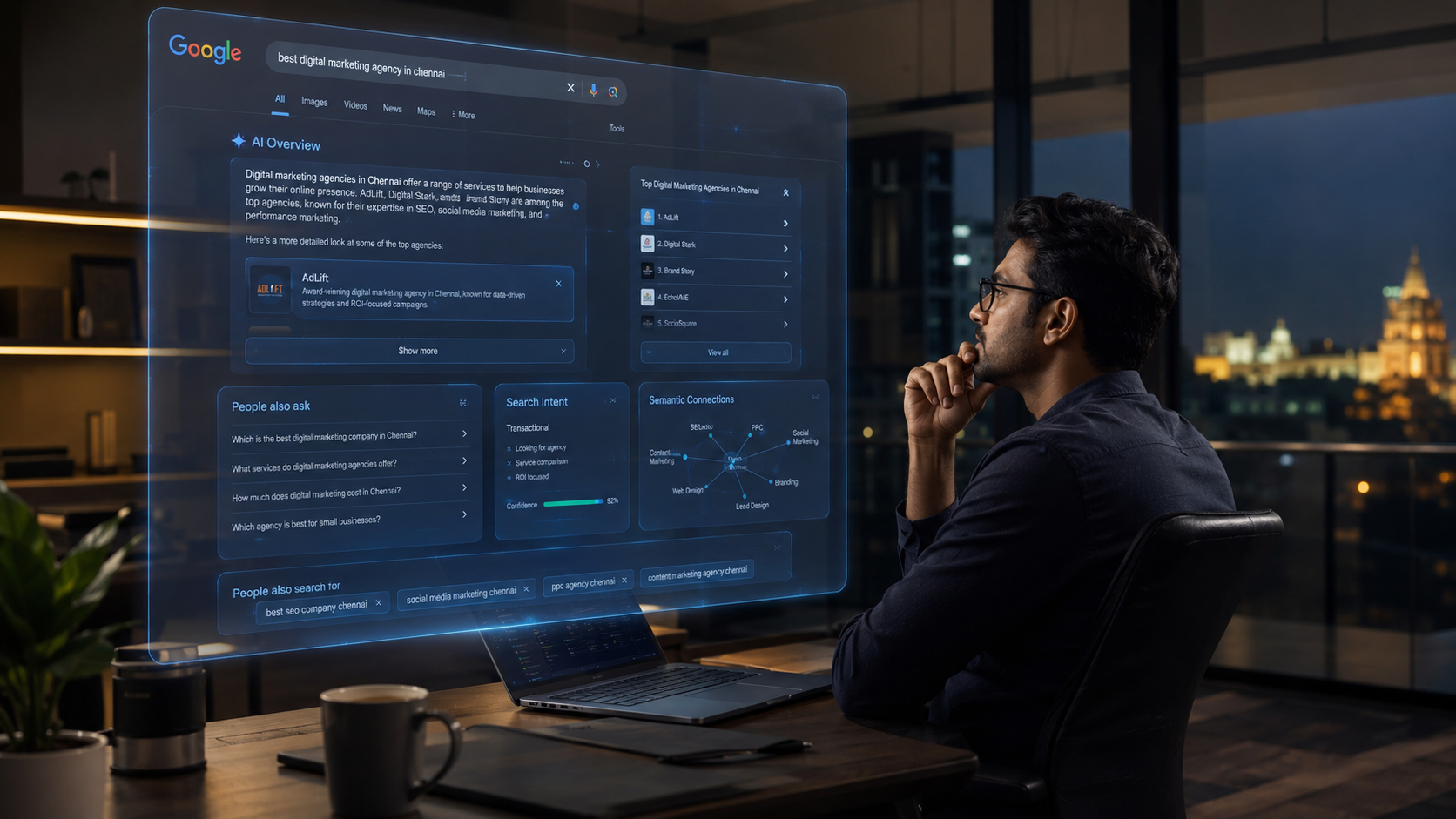
A lot of businesses still think SEO works the same way it did a few years ago. Rank on Google. Get clicks. Generate leads. Simple. But search behaviour has begun to change quietly and faster than most businesses realize. That’s where Google AI Overview SEO comes in.
Now, when people search for something on Google, they’re increasingly seeing AI-generated answers before they even reach actual websites. In some cases, users get the information they need without clicking anything at all.
That changes the game.
A Chennai business that once depended heavily on traditional search traffic may suddenly notice fewer clicks even if rankings haven’t completely dropped. Not because SEO stopped working. But because Google itself is evolving into something very different.
This is where Google AI Overview SEO becomes important.
And honestly, many businesses still haven’t fully understood how big this shift actually is.
What Is Google AI Overview?
Google AI Overview is Google’s AI-generated response that appears at the top of certain search results.
Instead of only showing website links, Google now tries to summarise answers directly inside search using artificial intelligence.
For example, if someone searches:
- “How to improve local SEO?”
- “Best digital marketing strategy for clinics”
- “Why is my website traffic dropping?”
Google may generate an instant AI summary using information collected from multiple websites.
That means visibility is no longer just about ranking number one.
Your content now needs to be:
- useful,
- trustworthy,
- clearly structured,
- and contextually relevant enough for Google’s AI systems to understand.
That’s a very different SEO environment compared to traditional search.
digital marketing strategies for business growth
Why AI Overviews Are Changing SEO So Much
For years, SEO discussions mostly revolved around:
- backlinks,
- keyword placement,
- technical optimization,
- and rankings.
Those things still matter.
But Google’s AI systems now evaluate content differently, too.
They look at:
- search intent satisfaction,
- topical relevance,
- expertise,
- semantic meaning,
- readability,
- and overall usefulness.
This is one reason many generic blogs are struggling now.
You’ve probably seen those articles before. The kind written only to “sound SEO friendly.”
Long introductions.
Repeated keywords.
Empty explanations.
No real insight.
That content style is becoming easier for both users and search systems to ignore.
Meanwhile, businesses creating thoughtful, experience-driven content are slowly gaining more visibility.
The Bigger Problem Most Businesses Don’t Notice
A lot of websites are publishing more content than ever.
But very little of it feels genuinely useful.
That’s the real issue.
The internet is now flooded with AI-generated blogs saying the same thing in slightly different ways. And because of that, originality has quietly become a major ranking advantage again.
Google wants information that actually helps people.
Not content written only to fill pages.
For example, a Chennai-based roofing company explaining how local search behaviour affects lead generation feels far more authentic than a generic article copied from global SEO trends.
Real-world context matters now.
More than many businesses realize.
How Businesses Can Optimize for Google AI Overview SEO
1. Focus on Search Intent Instead of Just Keywords
Many businesses still start SEO with:
“What keyword should we target?”
That approach alone is outdated now.
Modern SEO is more about understanding why someone searched in the first place.
If someone searches:
“Why is my website getting traffic but no leads?”
They usually don’t want a textbook SEO definition.
They want clarity.
Practical reasons.
Real explanations.
Content that genuinely resolves confusion tends to perform much better in AI-powered search.
Click here for professional SEO services
2. Build Topic Depth Instead of Random Blogs
One common mistake businesses make is publishing disconnected topics every week.
One blog about Instagram.
Another about logos.
Then suddenly one about AI.
There’s no topical structure.
Google increasingly rewards websites that demonstrate depth in a subject.
For example, if a digital marketing agency wants authority in AI SEO, it should naturally build related content around:
- AI search optimization,
- conversational search,
- semantic SEO,
- Google AI Overview,
- ChatGPT SEO,
- and content quality.
This creates topical authority over time.
3. Write More Naturally
Ironically, the rise of AI content is making human writing more valuable again.
A lot of AI-written blogs sound technically correct but emotionally flat.
Real human writing has rhythm.
Some sentences are short & reflective.
Some feel slightly opinionated.
That variation creates authenticity.
And authenticity is becoming a stronger trust signal online.
Especially now.
4. Improve Structure and Readability
Even though writing should feel natural, structure still matters a lot.
Google’s AI systems prefer content that’s easy to understand.
That includes:
- clear headings,
- short paragraphs,
- FAQ sections,
- logical flow,
- and readable formatting.
Dense blocks of text usually perform poorly for both users and AI extraction.
Simple readability improvements can significantly improve engagement.
Will Traditional SEO Still Matter?
Yes. Absolutely.
Technical SEO is still important.
So are:
- backlinks,
- mobile optimization,
- page speed,
- indexing,
- and website performance.
But those things alone are no longer enough.
The businesses likely to perform best moving forward are the ones combining:
- technical SEO,
- topical authority,
- semantic relevance,
- strong content quality,
- and real user value.
That combination is becoming much harder to fake.
What This Means for Businesses in Chennai
Many local businesses still underestimate how quickly search behaviour is changing.
Whether it’s:
- clinics,
- interior designers,
- educational institutes,
- roofing companies,
- restaurants,
- or service businesses,
Online visibility is becoming more competitive and more AI-influenced.
Businesses that adapt early may gain a strong long-term advantage while competitors continue following outdated SEO habits.
Because this shift is not temporary.
AI-powered search is only going to become more important from here.
FAQs
What is Google AI Overview SEO?
Google AI Overview SEO refers to optimizing content so it has a better chance of appearing in Google’s AI-generated search summaries.
Is traditional SEO still important in 2026?
Yes. Traditional SEO still matters, but it now works alongside semantic SEO, topical authority, and AI-focused content optimization.
Can small businesses benefit from AI SEO?
Definitely. Smaller businesses with useful and well-structured content can still gain strong visibility in AI-powered search results.
Why are some websites losing traffic after AI Overviews?
In some searches, users now get answers directly from Google’s AI summaries, reducing clicks to websites with weaker content value.
How can businesses prepare for AI-powered search?
Businesses should focus on:
- better content quality,
- search intent,
- topical authority,
- semantic SEO,
- and natural user-focused writing.
Final Thoughts
Google AI Overview: SEO is not just another digital marketing trend that businesses can casually ignore.
Search itself is changing.
Users are interacting differently with Google.
AI-generated summaries are reshaping visibility.
And average content is becoming easier to filter out.
The businesses that succeed over the next few years probably won’t be the ones publishing the most content.
They’ll be the ones publishing the most useful content.
More thoughtful.
More experience-driven.
& genuinely human.
That’s where modern SEO is heading now. latest AI SEO trends
And honestly, it was probably heading there all along.